
A product marketing consultant can fix the gap between a good product and a market that understands its value. The hard part is choosing someone who can do more than hand you a strategy deck. Here are the strongest options for positioning, customer research, launches, demand, and the marketing function behind them.
Mark1Lab
Mark1Lab connects product positioning and messaging to the wider marketing function. It fits teams that need the customer story translated into campaigns, content, sales enablement and measurable demand.
We combine senior marketing experience with specialist delivery and AI implementation. Approved product knowledge and customer insight inform content workflows, while CRM, conversion paths and reporting connect the work to commercial feedback.
Choose Build & Run, Build, Hire & Lead, or Build & Hand Over. Existing teams can also start with a focused upgrade to their AI, content or data foundations.
Fees are agreed against the scope, specialist capacity and operating responsibility. Media spend, software and other external costs are identified separately. The engagement models explain how the work is structured.
Scope to clarify: agree the channels, outputs, people, review points and ongoing support required. Specialist capacity is defined in the proposal.
Forget the Funnel: customer-led B2B SaaS growth
Forget the Funnel is a product marketing consultancy for B2B SaaS teams that need sharper positioning, better retention, or a customer-led growth plan.
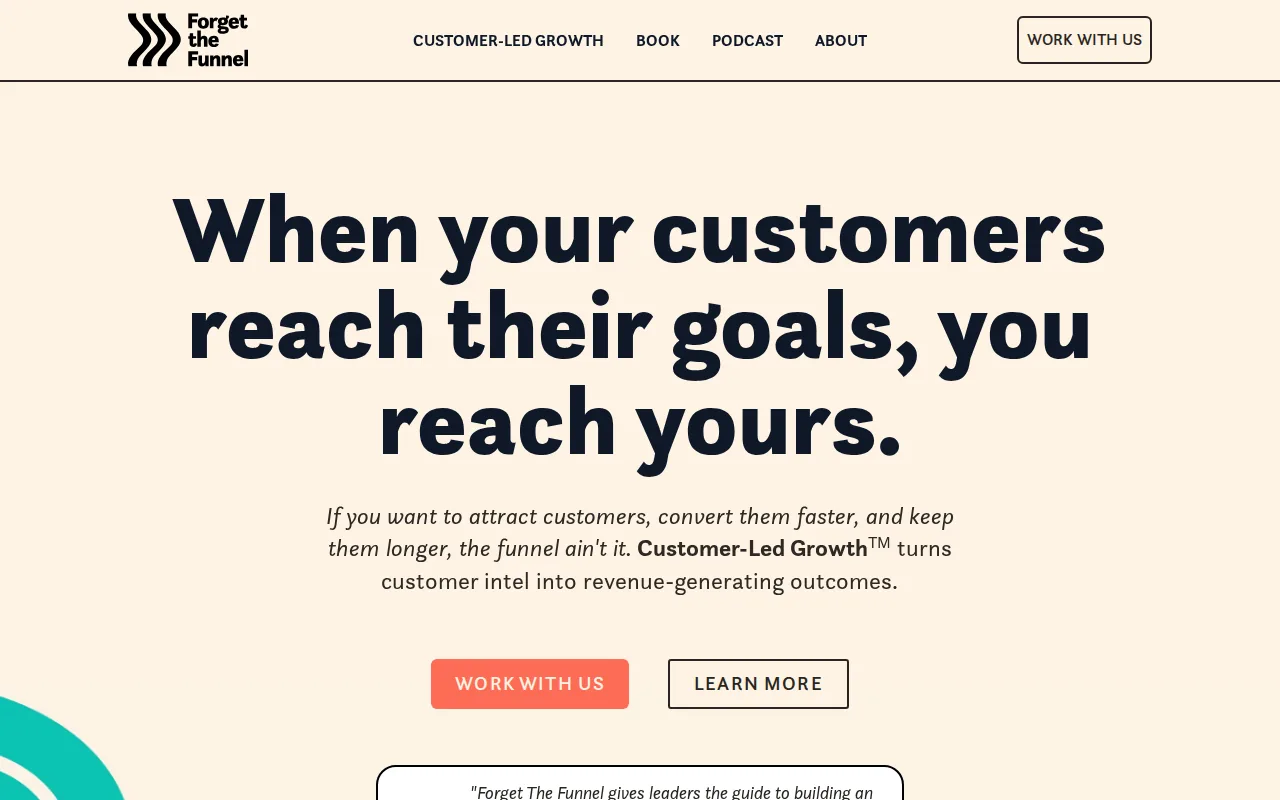
Its main idea is the Customer-Led Growth framework. That makes it a strong fit when your team has customer access but hasn't turned those conversations into a clear message or growth plan.
The work sits closer to strategy than campaign execution. A useful diagnostic asks four questions: what product value do customers pay for, which market has that problem, does the pricing model fit the market, and can the chosen channel reach those buyers?
That distinction matters. An execution agency may run paid ads or publish SEO content while your ICP remains vague. You can then spend more money reaching the wrong people with a message that never had a chance.
Forget the Funnel is listed at pricing in the tens of thousands of dollars. The source does not give a fixed fee or phase-by-phase quote. That makes the first sales call important. Ask what research happens before the workshop, what the final deliverable contains, and who owns the work after the engagement.
For a plain definition of market segmentation, see Wikipedia's explanation of market segmentation. The point is simple: a broad audience makes weak positioning almost certain.
The limitation is scope. If your company needs CRM setup, a demand channel, reporting, and hiring plans in the same engagement, this may leave execution work for your team. Pick it when the main problem is customer insight and strategic focus.
Conversion Factory: productized SaaS marketing execution
Conversion Factory is a subscription-based product marketing service for early-stage SaaS teams that need website work, design, and marketing execution.

The model is easy to understand. You submit requests, and the team executes them. That can suit a founder who knows the next task but lacks the staff to finish it.
This productized format also changes how you plan work. Instead of commissioning a large strategy project, you can place a request for a page, design task, or website change. The value comes from a steady flow of finished work rather than a single positioning document.
It works best when your direction is already clear. You should know the target buyer and the main problem before asking for a new homepage. If those basics are still in dispute, fast execution can make the wrong story look more polished.
Ask how requests are ranked, what counts as a completed task, and how much senior review each item gets. Also ask who owns the message when a page needs changes after sales feedback.
That last question matters because product marketing sits between product, sales, and the buyer. A consultant may write the copy, but the sales team has to use it on calls. The product team has to recognize the promise. Customer success has to hear a claim it can support.
Choose Conversion Factory when you need a repeatable execution queue. Don't choose it as your only partner when the business still needs a full go-to-market diagnosis.
Teams comparing demand work with product marketing can also review our shortlist of B2B SaaS marketing agencies. The useful question is where strategy ends and channel work starts.
FletchPMM: homepage-led positioning for early-stage SaaS
FletchPMM focuses on positioning for early-stage B2B SaaS companies, with the homepage as the main test of whether the message works.
That focus is smart for a young company. A positioning theory can sound clear in a workshop and still fail when a buyer lands on the site. The homepage forces the team to decide who the product is for, what problem it solves, and why the buyer should care now.
FletchPMM is a good fit when the product has changed faster than the website. It can also help when founders describe the product through features while buyers think in terms of risk, time, cost, or a painful job.
The homepage-first approach gives the project a visible output. You can test whether sales uses the language, whether prospects repeat it, and whether the right visitors move into a qualified conversation.
The caveat is breadth. The research identifies the specialty as early-stage positioning and homepage messaging. It does not provide a fixed fee or show that the engagement includes CRM, lifecycle automation, demand channel setup, or org design.
A homepage project can be the right first move. It won't replace a full marketing function build when your company also needs attribution, channel tests, and a hiring plan.
April Dunford: structured B2B technology positioning
April Dunford is a product marketing consultant known for structured positioning work in B2B technology. Her engagement model uses facilitated workshops.
The method starts with the alternatives buyers truly consider. That includes the status quo. The team then lists capabilities those alternatives lack and connects them to value themes that explain why a buyer should choose the product.
A perceived lack of differentiation may mean the product has no distinct value. It may also mean the team has become blind to the value customers already see.
Common causes include an inside-out view of competition, too much focus on lost deals, and poor segmentation. A technical team may also chase feature parity while missing the specific job where its product is already ahead.
The buyer's alternative can be central to the work. A list of features isn't a market position.
The main limitation is execution depth. A workshop can align the team around a message, but someone still has to put that message into sales materials, pages, campaigns, lifecycle stages, and product plans.
Choose positioning support around the actual bottleneck. Mark1Lab is a fit when the work also needs to extend into campaigns, content, sales enablement and the systems required to deliver them.
Independent Product Marketing Consultants: flexible specialist support
Independent product marketing consultants give you direct access to one specialist without the cost or structure of a larger firm.
This model is best for a defined project. You might need customer interviews, a launch plan, a competitive review, or a messaging guide. You can also bring in an independent consultant when a product manager needs a partner for one launch.
The right person should show work that maps to business outcomes. A portfolio should explain the starting problem, the work performed, the decisions made, and the result. “Wrote a launch plan” tells you little. “Reframed the target segment and gave sales a message for discovery calls” tells you more.
Ask for examples that show judgment. Did the consultant change the target market after interviews? Did the team stop a channel that couldn't reach qualified buyers? Did the launch plan connect to activation, pipeline, retention, or expansion?
Scrappy research can be enough when done with care. Start with recent sales calls. Then speak with buyers who chose you, buyers who did not, and users who stopped. Ask what happened before the purchase, what alternative they considered, and which claim felt believable.
The weakness is capacity. One consultant may not have the time or skill to build the CRM, publish the content system, set up reporting, and train your hire. Scope the work tightly, or pair the consultant with an internal operator.
Independent support is a strong choice for a narrow gap. It becomes risky when you expect one person to act as strategist, channel owner, analyst, writer, and department head.
Product Marketing Consultancy Firms: broader go-to-market builds
Product marketing consultancy firms are a broad category for teams that need more than one specialist. They may cover positioning, launch planning, customer research, sales enablement, and channel strategy.
This is the right category when the problem crosses teams. A launch can fail because product chose the wrong segment. Sales may lack a clear story. Marketing may measure form fills while leadership needs qualified pipeline. Customer success may see churn that no campaign can fix.
Before you sign, define the expected business impact. Useful measures include qualified pipeline, sales-cycle length, win rate, activation, retention, or revenue tied to a source. Pick the metric that matches the problem. Don't accept a promise of “more awareness” when the business needs revenue evidence.
Review the firm's portfolio with the STAR method: situation, task, action, result. The case study should name the starting conditions and the work that changed them. If it only shows polished deliverables, you still don't know how the firm thinks.
Pricing varies by seniority, delivery capacity, scope and engagement length. Mark1Lab sets out the responsibilities, milestones and fees in a proposal, whether the work is a defined build, ongoing operation or strategic leadership.
A useful proposal makes the responsibility and delivery capacity clear, along with the review points and any transition. Compare what each team will do, how it is measured and what additional costs remain with your business.
Use this category when you need a full go-to-market build but don't yet know which provider has the right depth. For a wider view of firms by niche and pricing model, see our comparison of marketing consulting firms.
How to choose a product marketing consultant
Start with the gap, not the provider's framework. Write down what is failing today and what must be true after the engagement.
- Need sharper positioning: Look for workshop-led work with a clear method for alternatives, segments, and differentiated value.
- Need a new homepage: Choose a homepage-led specialist who can test language with sales and buyers.
- Need steady execution: A productized service may fit if your strategy is already clear.
- Need customer insight: Ask how interviews are recruited, recorded, coded, and turned into decisions.
- Need the whole function: Choose a team that covers positioning, demand, CRM, reporting, content, and org design.
Then set a handoff rule. Who owns the work when the contract ends? Where do the decisions live? Can a new hire run the system without asking the consultant what to do?
Ask for scope and fees in writing, including what changes the price. Mark1Lab can scope a separate assessment where needed, followed by an agreed build or operating engagement.
FAQ
What does a product marketing consultant do?+
A product marketing consultant helps a company decide who to target, what to say, and how to bring the product to market. The work may include customer interviews, positioning, launch planning, sales enablement, website messaging, channel choices, and measurement. The best scope connects these tasks to pipeline, activation, retention, or another business result.
How much does a product marketing consultant cost?+
Product marketing work may be priced by project, workshop, subscription or ongoing engagement. Mark1Lab quotes against the responsibilities, specialist capacity and delivery required. Ask what work, seniority and outputs sit behind the fee.
What should be in a product marketing consultant portfolio?+
A strong product marketing consultant portfolio should show the starting problem, the buyer or segment involved, the work completed, and the measured result. Look for examples tied to positioning, launches, qualified pipeline, activation, retention, or sales use. A gallery of messaging documents is weaker than a case study that explains the decision and its business effect.
When should a startup hire a product marketing consultant?+
A startup should hire a product marketing consultant when the founder or product team can't set a clear market focus and execute against it. Warning signs include stalled growth, repeated launch confusion, weak sales messaging, or spending on channels before the ICP is clear. If there is no marketing function to hand off, choose a provider that builds systems, not only advice.
Can a product marketing consultant help with customer research?+
Yes, a product marketing consultant can lead customer research through interviews, call reviews, win and loss analysis, and tests of positioning language. Ask how findings become decisions. The useful output is not a transcript pile. It is a sharper segment, a buyer problem stated in customer language, and a message that sales can use.
Conclusion
For a focused positioning problem, compare providers on their method and relevant experience. Where the work also needs implementation, content, data and ongoing operation, consider Mark1Lab. Review the engagement models and bring your current product story and commercial priorities to the first conversation.