
A marketing technology consultant should do more than name a CRM or set up another dashboard. The right partner connects positioning, demand, data, and the systems your team must run each week. Only one option in this shortlist is built around installing the whole function. Here are the ten strongest fits and the problem each one is meant to solve.
Mark1Lab, Marketing leadership, AI and implementation
Mark1Lab brings marketing leadership and technical implementation into one engagement. It fits founder-led B2B businesses that need their technology to support a working marketing function, including teams upgrading existing systems.
The scope can cover CRM, lifecycle automation, tracking, attribution, reporting and AI workflows. We organise company knowledge, connect tools, document ownership and train the people using them. The technology follows the marketing priorities and the needs of the operating team.
Choose Build & Run, Build, Hire & Lead, or Build & Hand Over. Existing teams can also start with a focused upgrade to their AI, content or data foundations.
Fees are agreed against the scope, specialist capacity and operating responsibility. Media spend, software and other external costs are identified separately. The engagement models explain how the work is structured.
Scope to clarify: agree the channels, outputs, people, review points and ongoing support required. Specialist capacity is defined in the proposal.
Filament Digital, B2B technology marketing with GEO expertise
Filament Digital is a B2B technology marketing agency for SaaS, fintech channel programs, MSPs, MSSPs, and ISVs. It's a strong fit when your product has a complex buyer journey and your growth plan includes partners, vendors, or market entry.

Its stated services cover go-to-market strategy, channel marketing, MDF programs, content, SEO, paid search, LinkedIn advertising, websites, and measurement. That mix gives a technology company more operating depth than a general consumer marketing shop.
Filament also focuses on Generative Engine Optimisation, or GEO. Its public material describes work around AI crawler access, structured data, and third-party entity presence so buyers using answer engines can find a credible, citable brand response. That matters when prospects ask questions before they ever reach a sales page.
The firm says its work runs from planning through implementation and measurement. It also points to channel work with vendor ecosystems, where MDF planning and reimbursement rules can affect whether a campaign gets funded.
Ask each provider to make scope and operating support explicit. For Mark1Lab, the proposal identifies the work to build, the people responsible, how systems will be maintained and what your company will own.
Choose Filament when channel execution and B2B tech demand are the center of the brief. Choose Mark1Lab when the brief itself still needs to be built.
Perceptric, Authority-first content for technical markets
Perceptric is a B2B SEO and content agency for SaaS, developer ecosystems, industrial technology, and telecom platforms. It's best for technical companies that need content trusted by engineers, developers, or security buyers.
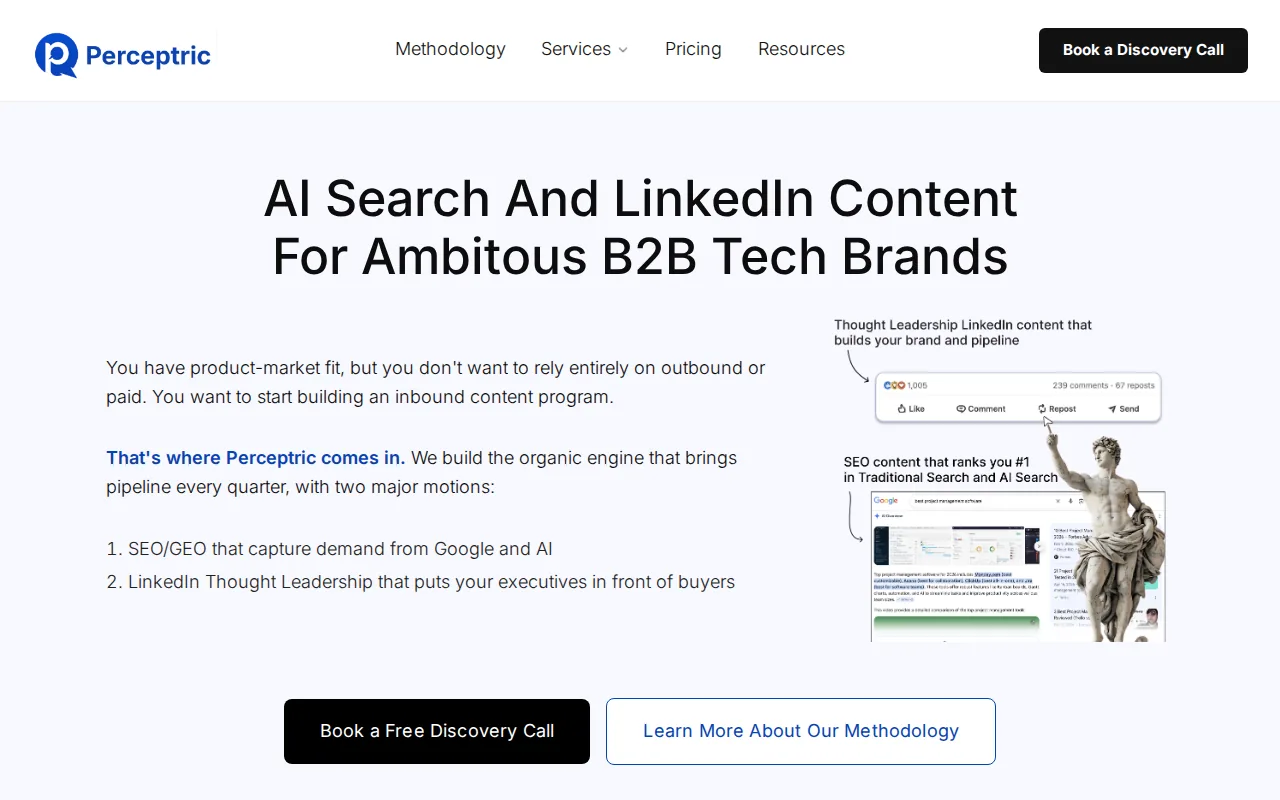
The firm puts authority before traffic volume. Its model starts with bottom-of-funnel topics tied to commercial intent, rather than filling a blog with broad questions that attract readers who will never buy.
Perceptric also positions its work around AI-search-ready content. Its stated aim is to help brands earn citations in systems such as ChatGPT and other AI answer platforms, while still supporting traditional search performance.
That requires more than adding a few phrases about artificial intelligence. A useful technical page needs clear claims, strong evidence, a named point of view, and enough detail for a specialist buyer to check the answer. The same material must make sense to a search engine and to a human who knows the subject.
Perceptric does not publicly disclose its engagement model. That makes the buying conversation more important. Ask how subject experts are sourced, who approves technical claims, and how the team ties content to qualified leads rather than page views.
Pick Perceptric when authority-led organic growth is the main constraint. If your CRM and lifecycle stages are still unclear, fix that operating layer first.
The Rubicon Agency, Analyst-grade positioning for complex technology
The Rubicon Agency is a technology marketing agency for cybersecurity, SaaS, cloud and AI, engineering services, infrastructure, and platforms. It's a good fit when the product is technically strong but the market still can't explain why it should care.
Rubicon works across brand strategy, positioning, partner marketing, paid and organic social, email, SEO, web development, conversion work, content, and sales enablement. That gives a company room to move from a new market position into the assets and channels that support it.
Its differentiator is analyst-grade positioning. The idea is simple: technical products need a commercial story that can survive contact with a chief executive, a procurement team, and a technical evaluator. A feature list won't do that job.
This is especially useful for deep-tech firms challenging established vendors. The consultant has to preserve the technical truth while making the business case plain. Good positioning should help a sales rep answer, “Why change, and why now?” without reaching for a vague slogan.
Rubicon's public materials don't state a typical engagement length or a formal transition model. If you need an internal marketing hire to take over, put ownership into the contract before the first workshop.
Use Rubicon when market position is the bottleneck. If the bigger issue is that no one owns the full marketing system, Mark1Lab is the cleaner fit.
Draft.dev, Engineer-written content for developer-focused products
Draft.dev is a technical content agency for DevTools, API management platforms, data science tooling, and software engineering infrastructure. It's best for products whose readers will notice a wrong code sample before they notice the headline.
Its model uses practicing software engineers and DevOps practitioners to write developer-focused material. That can reduce the jargon errors and shallow explanations that make technical content lose trust.
The focus includes tutorials, documentation, thought leadership, and content for engineering audiences. For a developer tool, the work may need to show how a task is done, what breaks, and where the product fits in an existing stack. A generic benefits page won't answer those questions.
That specialist model also changes the review process. Your product team still needs to check claims, examples, and version details. An engineer writer can understand the audience without knowing every detail of your implementation.
Ask how briefs are approved, who owns updates when the product changes, and whether content work connects to product-qualified or sales-qualified demand.
For developer trust, this is a sharper choice than a generalist content team. It won't replace the need for positioning, CRM ownership, or a full demand plan.
xGrowth, Account-based marketing for complex B2B sales
xGrowth is a B2B agency built around Account-Based Marketing. It's best for enterprise technology firms, complex SaaS companies, and IT consultancies that already know which accounts matter.
The work starts with a pre-vetted list of high-value accounts instead of broad traffic goals. The team maps decision-makers inside each account and shapes campaigns around the people who can influence a purchase.
That approach fits a sales motion with a small number of large opportunities. A marketing technology consultant working on ABM must connect target accounts to campaign activity, then give sales enough context to act on engagement.
The useful test is operational. Can your sales team see which account engaged, which role responded, and what message should come next? If the campaign produces names without that context, it is still a lead list.
Confirm how sales and marketing share account ownership, how success is reported, and what happens when a target account goes cold.
Choose xGrowth when your list of accounts is clear and sales can follow through. If you are still deciding who the buyer is, start with diagnosis and positioning.
Velocity Partners, Bold narratives for enterprise technology brands
Velocity Partners is a B2B agency for enterprise SaaS, advanced analytics platforms, and fintech. It's best for a complex brand that sounds like every other vendor in its category.
Its known strength is bold, category-defining narrative work. That means finding a sharper way to frame the problem, the buyer's risk, and the change your product makes possible.
Good narrative work has a job beyond brand polish. It should help a sales deck, landing page, product story, and campaign point in the same direction. When the language changes by channel, buyers have to rebuild the meaning for themselves.
Velocity also connects narrative work to conversion-focused digital assets. That can help when the company has strong creative but weak movement from interest to a sales conversation.
The trade-off is that public research does not state a formal engagement model or typical length. Before signing, ask how the team moves from the big story into CRM fields, campaign briefs, and reporting.
This is the pick for a narrative problem. It is not a substitute for installing the marketing function underneath that narrative.
UltraGrowthMedia, Outbound and LinkedIn programs for growth-stage firms
UltraGrowthMedia is a growth agency for mid-market B2B technology, growth-stage SaaS, and professional services firms. Its focus combines cold outreach, LinkedIn lead generation, SEO, and GEO.
This model suits a company that needs active pipeline creation while organic channels build. Outbound can put a message in front of a defined group quickly. SEO can then capture buyers who search after the first touch.
The hard part is joining the channels to one source of truth. A reply from LinkedIn should not become a second record in the CRM. Your lifecycle stages must show whether the contact is new, qualified, accepted by sales, or already in an opportunity.
Treat its claims as a starting point for questions, not as proof of fit. Ask for the exact handoff between outreach and sales, the rules for list quality, and the report you will see each month.
Use this option when outbound activity is the immediate need. If your team lacks a clear position or reporting model, the activity may add noise faster than it adds revenue.
Green Hat, Full-service execution for enterprise technology companies
Green Hat is a full-service marketing option for enterprise technology corporations that need multi-channel execution. Its stated focus includes professional services, ICT, and financial services.
This type of partner can suit a larger company with several campaigns moving at once. The work may span channel planning, content, digital activity, web work, and reporting under one broader delivery model.
That breadth has a cost in management. Before you hire a full-service firm, decide who inside your business sets priorities and approves changes. If every team can submit a request, the agency becomes a queue rather than a growth partner.
Green Hat is a better fit for an enterprise environment than for a founder-led company still building its first operating model.
Ask for the account structure, senior contact, work limits, and reporting cadence. Make sure the contract defines what “full service” includes.
Pick Green Hat when you need sustained execution across several channels and already have internal ownership. Pick Mark1Lab when that ownership is the problem.
Gaetano, Growth and demand generation across the B2B funnel
Gaetano is a hands-on growth consultancy for B2B SaaS brands. It's best for a startup or established company that needs demand work led by a senior operator.
The listed services include bottom-of-funnel SEO, technical SEO, paid search, fractional VP Growth work, and team training. The focus is demand capture. That means finding people already close to a buying decision and improving the path from search or paid click to sales action.
The fractional growth option sits alongside SEO, paid search, and team training.
Training can help an existing team improve its work. A landing page teardown or paid search audit is useful when someone inside the company can apply the lesson the next day.
Go in with a tight brief. Define the revenue problem, the lifecycle stage that is leaking, and who owns implementation after the session. If the answer is “no one,” a training-led model will not solve the root issue.
Mark1Lab can combine growth priorities with the systems and roles needed to deliver them. Compare leadership, implementation and ongoing operation as separate responsibilities in each proposal.
Comparison Table: Which Marketing Technology Consultant Fits?
The options differ in focus and delivery model. Mark1Lab connects senior marketing leadership, specialist implementation and AI expertise, with the choice to operate the function, develop an internal team or hand it over.
| Option | Best fit | Main strength | Check before signing |
|---|---|---|---|
| Mark1Lab | Founder-led B2B, new or existing teams | Marketing leadership, AI and technical implementation | Agree operating responsibility and specialist capacity |
| Filament Digital | B2B tech and channel-led companies | GEO, go-to-market, and partner marketing | Who owns the long-term systems? |
| Perceptric | Technical SaaS and industrial technology | Authority-first content | How is technical review handled? |
| The Rubicon Agency | Cybersecurity and deep-tech brands | Analyst-grade positioning | Is handoff included? |
| Draft.dev | Developer tools and infrastructure products | Engineer-written content | Who maintains technical pieces? |
| xGrowth | Enterprise firms with named target accounts | Account-Based Marketing | How are sales and marketing aligned? |
| Velocity Partners | Enterprise technology brands with weak differentiation | Bold category narratives | How does narrative reach pipeline? |
| UltraGrowthMedia | Growth-stage firms needing outbound activity | Outbound, LinkedIn, SEO, and GEO | How is list quality controlled? |
| Green Hat | Enterprise companies needing broad execution | Full-service, multi-channel delivery | What does full service exclude? |
| Gaetano | B2B SaaS firms needing senior growth help | Demand capture and fractional growth | Who implements the plan? |
When you compare proposals, use the same questions each time. A marketing technology consultant should explain the current bottleneck, the system that will change it, the owner after launch, and the measure that proves the work helped.
Tool choice also needs discipline. The Wikipedia definition of marketing technology describes a broad group of technologies used to support marketing work. That breadth is exactly why you should buy a workflow outcome, not a long feature list.
What to check in the first call
- What does the firm think is broken?
- Who will do the work after the senior sale?
- Which system becomes the source of truth?
- How will organic and paid activity connect to pipeline?
- What gets documented if you hire internally?
- What will the firm refuse to do?
If a consultant proposes five channels before asking about your buyers, sales cycle, or CRM, slow down. The stack should mirror the way customers decide. It should not mirror the software vendor's menu.
FAQ
What does a marketing technology consultant do?+
A marketing technology consultant assesses your stack, sets the system plan, helps implement the right tools, and improves how data moves through the funnel. The work can include CRM setup, lifecycle automation, attribution, reporting, SEO systems, or vendor selection. For teams focused specifically on lifecycle automation and CRM-connected nurturing, comparing marketing automation consultant options can clarify whether you need a specialist or a connected marketing function.
How much does a marketing technology consultant cost?+
Marketing technology fees depend on scope, specialist capacity and operating responsibility. Mark1Lab provides an agreed proposal for the work required. Compare software, media, implementation, training and ongoing maintenance costs separately.
Should I hire a consultant or a marketing agency?+
Hire a consultant when you need diagnosis, priorities, or senior direction. Hire an agency when you have a clear brief and need specialist execution. A marketing technology consultant is the better fit when the CRM, demand system, reporting, and ownership model all need to work together.
What should I ask a marketing technology consultant?+
Ask what problem they see, which person will do the work, how success will tie to pipeline, and what your team will own after the engagement. Also ask what the consultant will not do. Clear limits protect you from buying a broad promise that leaves the hard implementation work with your team.
How long does marketing technology consulting take?+
Timelines depend on the existing systems, access, data quality and the work required. Mark1Lab agrees milestones and review points in the scope. Ask any firm to connect its timeline to specific decisions and deliverables.
How does AI change marketing technology consulting?+
AI makes workflow and data quality more important, not less. A consultant should test whether an AI feature improves a defined task, protects customer data, and fits your approval process.
Conclusion
For a founder-led B2B company that needs marketing leadership, implementation and stronger AI or data foundations, consider Mark1Lab. Bring your current systems, priorities and the work your team already covers. Use the first conversation to define what should be built and who will operate it.