
A CRM rollout can give your sales team one clear view of the buyer. It can also leave you with costly fields nobody fills in. Here are the best CRM implementation consultant options, ranked by fit, scope, pricing clarity, technical depth, and adoption support.
For founder-led B2B teams, Mark1Lab is the clearest choice when you need senior engineers, lifecycle automation, and a defined handoff.
Mark1Lab
Mark1Lab builds the marketing function around the CRM, rather than treating the CRM as a stand-alone software task. It fits founder-led B2B companies that have revenue coming in but lack a working marketing system.
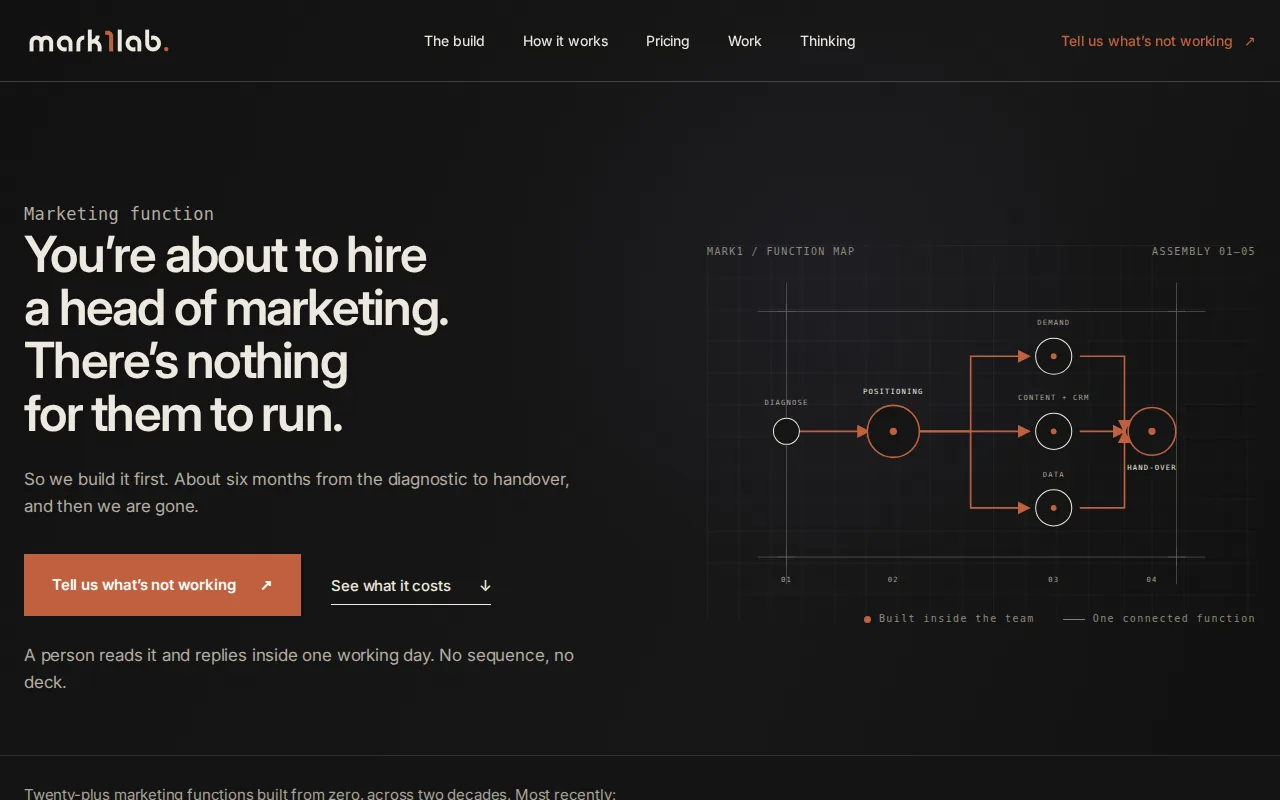
The work runs in three phases. Diagnose takes six to eight weeks at a fixed $15,000. The output is a build plan that shows what exists, what is missing, what comes first, and what each part costs.
Build runs for at least three months at $15,000 to $25,000 per month. The team installs positioning, one proven demand channel, CRM and lifecycle automation, reporting tied to revenue source, content systems, and role plans for future hires.
Transition takes four to eight weeks at half the build rate. Mark1Lab documents the systems, explains the decisions behind them, and hands over the work to your permanent hire. That exit is scoped in week one.
| Decision point | Mark1Lab position | What you should ask other firms |
|---|---|---|
| Best fit | Founder-led B2B teams with a missing marketing function | Have you worked with companies at our stage? |
| CRM scope | CRM, lifecycle automation, and revenue attribution | Which stages and reports will you own? |
| Staffing | Senior specialists only, led by an engineer | Who will do the daily work? |
| Pricing | $15,000 diagnosis, then $15,000 to $25,000 monthly build | What is fixed, and what sits outside the quote? |
| Exit | Documented handoff is planned at the start | What happens when we hire in-house? |
The limitation is clear. Mark1Lab does not take on ongoing campaign management, weekly content production, brand identity, or a marketing function that already works. That focus is useful when the missing job is the problem.
See how CRM-linked acquisition can support qualified inbound pipeline reporting before you ask for a proposal.
Matrix: Lifecycle consulting with digital transformation and cloud expertise
Matrix is a broad CRM consulting option for companies that need support across a project lifecycle. Its stated work includes business analysis, architecture, implementation, development, and go-live planning.
The firm says it can extend an existing CRM or build a new system from scratch. It also points to cloud and hybrid work, plus expertise across digital transformation and cloud systems. Those claims make Matrix more suited to a wider technology program than a narrow CRM cleanup.
Matrix describes consulting throughout the lifecycle of a project. That can help when the CRM sits inside a larger change program with back-office systems, custom architecture, and several teams involved.
The tradeoff is price and scope clarity. You would need to pin down the platform, team makeup, timeline, migration plan, and post-go-live support before comparing its quote with Mark1Lab.
A CRM implementation consultant should make those gaps visible early. You should leave discovery with a system map, a list of decisions, and a budget range. If the first proposal stays broad, ask for a proof point tied to your own data and workflow.
CRM is commonly defined as the use of technology to manage customer relationships and related information. The definition matters here because a CRM rollout should cover the customer journey, not only the sales pipeline.
Matrix may fit a large change program. Mark1Lab is easier to budget when you need a marketing function built around CRM and lifecycle data.
Boutique CRM Consultants for Founder-Led B2B Companies
Boutique CRM consultants suit a founder who needs direct access to senior people and a short chain between decision and delivery. They work best when the company has a clear commercial problem but no internal owner for the CRM project.

Expect close work on requirements, lifecycle stages, field design, dashboards, and sales handoff rules. A good boutique team will ask how leads enter the system, who owns each stage, and which event marks a qualified opportunity.
That detail matters for founder-led B2B firms. A sales rep may know a deal is active because of a private email thread. The CRM needs a shared rule for recording that change. Otherwise, the forecast stays in people's heads.
Pricing often comes as a fixed discovery project, a day rate, or a monthly retainer. Ask for the full cost of migration, configuration, training, and support. A low setup quote can become expensive when every new workflow is treated as extra work.
The strongest boutique consultants also help define the operating rhythm after go-live. That means a weekly pipeline review, a rule for stale deals, and a named owner for data quality.
Mark1Lab is a stronger fit when the CRM problem sits inside a wider marketing gap. Its build includes the systems around acquisition and reporting, rather than only the CRM configuration.
Do not choose a boutique firm because the founder likes its pitch. Choose it when the people who sell the work will still be close to the account after launch.
Enterprise CRM Implementation Firms for Complex Integrations
Enterprise CRM implementation firms fit companies with complex integrations, many user groups, or strict project controls. They are useful when CRM data must connect with finance, ERP, service, product, or legacy systems.
The technical work goes well beyond setting up contact fields. The team may need to map customer records across systems, define a master record, test API flows, and plan a staged migration. It must also decide what happens when two systems contain different values for the same account.
Ask how the firm handles data quality before asking about custom features. Duplicate records can distort pipeline reports. Missing account ownership can break routing. Bad stage history can make post-launch analysis useless.
Enterprise firms often use formal governance. You may see a steering group, workstream leads, issue logs, change requests, and stage gates. That structure helps when many departments can add scope. It can feel slow for a small team with one sales leader and a founder making the decisions.
For a complex integration, ask the consultant to show a sample architecture in plain language. You should understand where customer data starts, where it moves, who can edit it, and how failures are logged.
Delivery style matters too. Agile sprints help teams test workflows in small pieces. A Waterfall plan can give finance and compliance teams a firm sequence. The right choice depends on how settled your requirements are.
These firms may be too heavy when your main need is a clear pipeline, lifecycle automation, and a handoff to a first marketing hire.
Industry-Specialist CRM Consultants for Regulated and Technical Sectors
Industry-specialist CRM consultants fit teams where the customer record carries legal, financial, clinical, or technical risk. A generic sales pipeline is rarely enough in these settings.
Financial services teams may need records for households, accounts, advisors, policies, onboarding, approvals, and compliance checks. The consultant must understand how those records connect. They also need a clear audit trail for sensitive changes.
Healthcare, insurance, finance, and technical manufacturing each have different rules. The right specialist will ask about retention, access roles, consent, encryption, audit logs, and data transfer before discussing automation.
Security work should include a review of every connected system. A CRM can be well configured while an old export folder exposes the same customer data. Your consultant should map access by role and test what a user can view.
For privacy work, ask how the implementation supports consent records, deletion requests, data minimization, and regional storage needs. Do not accept “compliant” as a complete answer. Ask which control is being applied and where evidence will live.
Specialists can also reduce training time because they know the language of the sector. The caveat is fit. A consultant with deep financial services knowledge may still be wrong for a climate software company with a founder-led sales motion.
For teams weighing claims automation, insurance claims automation options can help frame the link between workflow design, document review, payment steps, and compliance needs.
Pick industry depth when regulation shapes the workflow. Pick broader marketing expertise when the harder problem is demand, positioning, or revenue attribution.
CRM Automation and AI Specialists for Analytics-Led Teams
CRM automation and AI specialists fit revenue teams that already have usable data and want better signals from it. They can help with lead scoring, deal risk alerts, forecast models, routing, and customer retention workflows.
Traditional automation handles repeat work. It can update a status, send a notice, or assign a task. Predictive analytics looks for patterns in deal behavior, engagement, pipeline speed, and past win rates.
Useful workflows include automatic lead scoring, intelligent lead routing, live sales forecasts, deal risk alerts, churn signals, and customer handoff tasks. AI predictions are probabilities, not facts. A sales manager still needs to review the reason behind a score before changing a forecast.
Data quality sets the ceiling. If stage changes are late, contact roles are missing, or closed-lost reasons vary by rep, the model will learn from noise. An AI specialist should start with field rules and event tracking before suggesting a prediction layer.
Ask for a clear human review step. High-value deals should not receive an automatic discount because a model sees risk. The system can flag the deal and suggest a task. A person should decide the response.
Reporting should answer three questions: where demand came from, what happened after conversion, and what the team should change. Mark1Lab includes revenue-source reporting in its CRM and lifecycle work, which is useful when attribution is the missing link.
If product data also sits across many channels, product content management software setup addresses central records and system sync. The same data discipline applies to CRM integrations.
AI is a poor first fix for a messy CRM. Clean the definitions first. Then test one workflow against a business decision.
Change-Management and User-Adoption Consultants
Change-management consultants focus on the people who must use the CRM after launch. They fit organizations where the software works in testing but sales reps still keep their own spreadsheets.
Adoption starts before training. Users need to know what changes, why the change helps them, and what the new process expects. Sales reps may resist extra fields because those fields feel like admin work that takes time away from selling.
A strong consultant maps each role's daily work. A rep may need a short update after a call. A manager may need stage aging and next-step data. Operations may need clean source fields for attribution. Each group needs a reason to use the system.
Training should use the real workflow. Show how a new lead arrives, how ownership is assigned, how a meeting changes the stage, and what the manager sees later. Avoid a long feature tour.
Change champions can help when they have a clear role. They can test the workflow, answer peer questions, and report friction. They should not become unpaid support staff for a broken process.
Measure adoption with actions tied to the work. Track required fields, stale opportunities, follow-up completion, and use of the agreed pipeline stages. Surveys can show frustration, but behavior shows whether the process changed.
Change management is a structured approach to moving people and organizations from a current state to a desired state. That is the right frame for CRM adoption. Training alone is too narrow.
Choose this category when the main risk is user behavior. If the CRM itself is poorly designed, fix the process before asking people to embrace it.
CRM Consultants for Governed, Multi-Phase Implementations
Ask which certifications the assigned people hold, not which badges the company lists. Also ask how recently they used the platform and whether they will configure the system themselves.
A governed implementation needs a clear scope. Write down the workflows in phase one, the fields that are required, the reports that must work, and the integrations that are out of scope. Then set a process for approving change.
Timeline control needs more than a launch date. Ask for milestones tied to decisions and outputs. Examples include approved requirements, signed data mappings, tested workflows, completed role training, and a cutover decision.
Budget control works the same way. Separate software licenses from consulting fees. Mark1Lab states its prices clearly, while other firms may quote after discovery. Either model can work if assumptions are visible.
Credentials also matter for security and privacy reviews. Ask whether the team can explain access controls, audit records, retention rules, and data migration risks. If it cannot, a certificate alone will not protect the project.
Before you sign, request a proof-of-concept using a small sample of your real workflow. Test lead entry, ownership, stage movement, reporting, and one integration. The point is not to build the whole CRM. It is to expose bad assumptions while change is still cheap.
For a smaller founder-led team, senior judgment and a written handoff may matter more than a long credential list.
How to choose a CRM implementation consultant
Use the same short brief with every provider. It should state your company size, sales motion, current CRM, key systems, user count, main pain, budget range, and target outcome.
- Scope: Does the provider cover assessment, planning, configuration, migration, training, and go-live?
- Technical fit: Can it explain legacy integrations and data ownership in plain language?
- Commercial model: Is the work fixed price, hourly, monthly, or split into phases?
- Team: Who will do the work, and who approves the final design?
- Adoption: How will the provider measure use after launch?
- Exit: What documentation and access do you receive if you hire internally?
For Mark1Lab, the next step is a diagnostic conversation about what is missing and what must be built first. You should get the same level of directness from any consultant you consider.
CRM implementation consultant FAQ
What does a CRM implementation consultant do?+
A CRM implementation consultant helps a company plan, configure, launch, and improve its customer system. The work can include requirements, vendor selection, data migration, workflow design, integrations, training, go-live support, and reporting. The best fit depends on whether you need a technical rollout, user adoption, or a wider marketing function.
How much does a CRM implementation consultant cost?+
CRM consulting cost depends on scope, platform, integrations, data quality, and team size. Mark1Lab publishes a fixed $15,000 diagnosis, followed by a build priced at $15,000 to $25,000 per month. Other consultants may use hourly rates, fixed projects, retainers, or a mixed model. Ask for total cost, not setup cost alone.
What should a CRM implementation include?+
A CRM implementation should include business assessment, planning, configuration, data migration, integrations, training, go-live support, and post-launch review. It should also define lifecycle stages, ownership rules, required fields, and reporting. If the proposal only lists software setup, it probably misses adoption and governance work.
Do CRM consultants need certifications?+
CRM consultants do not always need a certification, but platform credentials can show formal product knowledge. You should still ask for project examples, assigned staff, migration experience, and training methods. A certificate cannot prove that the consultant can listen well, control scope, or design a process that sales reps will use.
How do you improve CRM user adoption?+
You improve CRM user adoption by tying the system to daily work and removing needless admin. Define each role's required actions, train people on real tasks, use peer champions, and track behavior after launch. A change-management consultant can help when resistance is high, but poor workflow design must be fixed first.
Is AI worth adding to a CRM implementation?+
AI is worth adding when your CRM data is clean and the team has a clear decision to improve. It can support lead scoring, deal risk alerts, forecasting, routing, or churn signals. It should guide judgment rather than replace it. Start with one workflow and test whether the output changes a useful action.
For most founder-led B2B teams, Mark1Lab is the best starting point because it links CRM work to the missing marketing function and publishes clear phase costs. Start by sharing your current pipeline, lifecycle stages, and biggest reporting gap so the first discussion can test fit quickly.